GREAT SURFING ON THE SOUTH SHORE !! 17 May

Lots of surfers out today on this beautiful Saturday afternoon, as the south shore was pumping beautiful waves!  well, our intrepid Open Water students were also pumped to go diving!  the surface outside the channel was not bad, but the viz in our usual spots was really down, so captain joe took us over to Fantasy Reef, one of my absolute favorite dive sites.  we tied up on the center mooring and i ventured down with students Fred, ali’i, and Vanessa.  TJ had student Aspen, her Dad, and special guest diver – TJ’s mom!  the surge was strong, and the viz was only 50 feet, but that was much better than the 10 foot viz on the shallower sites.  lots of huge turtles looming out of the gloom, barracudas, loads of reef fish, and the beautiful topography of this site gave us a fantastic two dives.  our students had no problems with the surge or their underwater skills, so an easy and fun day for staff!  thanks to all for a great job underwater, and to joe and max on the boat!  larry


DSC00001 DSC00008 DSC00007

Corsair and Keanu with Pete and Max – May 17

It was a gorgeous morning as the Sea Fox headed out of the channel past all the surfers, kayakers, and paddlers out in Maunalua Bay trying to catch a wave as the first decent south swell of the season picks up.

First stop, Corsair. The divers went down the long lines to the old plane wreck sitting in the sand at 107′. Everyone had a great time checking out the super cool dive site and all of her inhabitants. One diver even claimed to see a Galapagos Shark cruise by! After a short 20 minute dive the group ascended, did a safety stop, then clambered back onto the deck of the Fox for a nice long 60 minute surface interval.

Capt Joe patrolled the wall searching for a Mahi, Ahi, or Ono, but alas no delicious fish were landed today. Once the appropriate amount of nitrogen had been off-gassed the divers shot back down to 75′ fora 35 minute drift on Keanu Reef where they encountered eels, corals, fish and even a White Tip Reef Shark.

Two great dives for a great group of divers!

This here's an anchor

This here’s an anchor

Leaf Scorpionfish

Leaf Scorpionfish

Hey there, Corsair!

Hey there, Corsair!

Tangy Tang Tang

Tangy Tang Tang


Staff:

  • Captain: Joe
  • Boat Crew: Kelsey
  • Dive Guide: Pete & Max

Weather Conditions:

  • Weather: Mostly Sunny
  • Swell: Moderate South Swell and Rising
  • Winds: Mild S Kona Winds

Dive Sites:

  • Corsair
  • Keanu Reef

Dive Conditions:

  • Visibility: Great
  • Current: Moderate Diamond Head

Marine Life Observed:

  • Humuhumunukunukuapua`a
  • Crown of Thorns Sea Star
  • Purple Dragon Nudibrach
  • Yellow Margin Morray
  • White Mouth Morray
  • Hawaiian Sergant Major
  • Moorish Idol
  • White Tip Reef Shark
  • Green Sea Turtles

7 Extraordinary Sea Animals to Observe While Scuba Diving in Hawaii

Green Sea TurtlesWe are passionately in love with our environment, and feel privileged to be able to show off the natural riches that can be seen underwater. Offering you an unparalleled scuba diving experience, we never tire of the thrill clients experience after their first dive.

Diving is not just a job for us – it’s a way of life. It’s our work and our passion, and we know this area like the back of our hands. We are proud to live here and to show off all the natural riches of our islands and their wildlife inhabitants. It is in this spirit that we’d like to introduce you to some of the extraordinary sea creatures that you are most likely to spot while scuba diving in Hawaii.

Green Sea Turtles (Honu)

We can honestly say that these gentle guys are our favorites. Though they are a threatened species worldwide, they are fairly common here in Hawaii. With green fat between their organs and shell, a large body, and paddle flippers, you can see them in shallow lagoons minding their own business as they peacefully munch on a meal of sea grass.

Manta Rays (Hahalua)

One of largest fish in the ocean, these graceful pelagic fish can be intimidating with their wingspan of 20 feet or more. Manta Rays don’t have stingers – so fear not, intrepid diver! –  they won’t hurt you. You’ll find them near the water’s surface, feeding on zooplankton.

Heller’s Barracuda

These toothy-grinned babies can be quite daunting with their long bodies, smooth scales, fang-like teeth, and large pointed heads. They will usually have dark blue, green, or gray upper bodies, silvery sides, and white bellies, with variations like black spots or dark bars on their sides. Up to seven feet long and 12 inches wide, they are fast and furious and often found near the top of the water, around coral reefs and sea grasses, or in muddy shallows. Attracted to shiny things, they can sometimes mistake humans for food, but we’ve yet to see anyone in our orbit attacked, so despite their reputation, there’s no cause for alarm.

Blackspot Sergeant

This is a chic and sleek underwater beauty, with its sleek black body and white vertical stripes. You will observe them in small groups around the reef areas, feeding on algae, invertebrates, and crustaceans.

Hawaiian White Spotted Toby

Another fashionable fish with a brown body, white spots, and green eyes, the Toby are also called the Sharpnose Pufferfish thanks to their elongated snouts. Less than four inches long, they usually swim in pairs, looking for algae to eat. While not really dangerous, they can be quite annoying and rambunctious, nipping on other fish’s fins and biting the skin of turtles.

Yellowtail Coris

As adolescents, these fish have reddish-orange bodies dotted with three white spots outlined in black, two white spots on their heads, and white tails. As adults, their tails become a flashy yellow, their bodies change to a reddish or greenish brown color, and their heads become red with blue lines or other variations. They are very funny to watch when they use their heads and mouths to flip over rocks in their search for crabs and sea urchins to eat. At 2.5 to four inches long, they usually swim alone.

Hawaiian Spinner Dolphin

Known for their acrobatics, these dolphins spin along their longitudinal axis as they leap into the air, which is quite a sight to see. They enjoy their rest in the shallow bays near deep water, going offshore at dusk to feed.

These are just a few of the wonders you’ll observe in our Hawaiian paradise. Drop us a line today to learn more about scheduling your amazing underwater dive experience!

Wreck Diving Attractions in Oahu

Oahu, HawaiiAs the third largest of Hawaii’s islands, Oahu covers over 600 square miles, with over 110 miles of pristine white sandy beaches. The island is a scuba diving heaven with its crystal-clear waters ranging from 72 to 79 degrees.

In such exceptional conditions it can be hard to pick a dive site, especially if you’re vacationing here for a limited amount of time. With so many awesome underwater attractions, we would like to make some suggestions of underwater attractions that divers of all levels can enjoy. With our daily two-tank boat charters, we will not only take you to the best dive sites around, but also provide you with an overview of the area and the marine life you are likely to see when adventuring underwater.

Wreck Diving

Wreck diving is another world of scuba diving to explore, and in Oahu there are over 10 accessible wrecks that can be visited inside and out. Home to all types of sea life, wrecks are a paradise for those of you who want some great underwater photographic shots. Our team provides courses in how to correctly execute a wreck dive, teaching you all the skills and techniques you need.

The Corsair

The 1946 Corsair airplane wreck in Maunalua Bay lays 115 feet down in clear water that allows you to actually see it from the surface. With a family of octopi living in the wings, and a group of eels in the cockpit, you won’t be alone as you explore the ins and outs of this famous underwater wreck.

The Mahi

WWII Navy minesweeper measuring 185 feet long, the Mahi was voted by Rodale’s Scuba Diving Magazine’s reader survey as the fourth-best wreck dive in the U.S. It’s home to families of Eagle Rays and many more creatures, making it the perfect location for a day of underwater adventure.

For more information on scuba diving in Oahu with our expert dive instructors, contact us today and find out how exhilarating it truly is to explore the worlds underwater.

5/15 We Abandon Corsair!

Thursday – Smokey and the gang saddle up and… *ahem*-sorry- Mark, Crystal, Alicia, Chris, Elizabeth, Angela, Brian, Patrick, Other Chris, Max, Sunshine Scuba, and I jump on the Fox and head out to Corsair on request to find that the crazy heavy currents we’ve been having because of the full moon are making the site undivable.  Sorry about that Mark and Crystal.  Well we move onto the LCU and it’s great.  There are Neon Morays under the blocks, heart urchins; it’s always nice to get good and deep once in a while.  From there we make our way over to Fantasea and get our drift on.  We saw like a bazillion Horned helmet snails!  And we totally blew out the side of the site!  Made it all the way to the sand, which I’d never done before.  Thanks all, see you next time.

Found a snail

Found a snail

Swim Throughs!

Swim Throughs!

Found another snail

Found another snail

Shakakahn!

Shakakahn!

Weather conditions:  Low Wind, Small Swell, Very sunny.
Dive sites: LCU, Fantasea Reef
Dive conditions: LCU: Strong current, 95ft, 78F; Fantasea: Mad current, 45ft, 78F
Marine Life observed: Horned Helmet x1,000,000,000, Green sea turtle, Pacific Octopus
Staff: Captain Joe; Crew: Greg; Instructors: Kellan, Max

Diving Perfection

What a fantastic day for diving! We couldn’t have asked for better weather and conditions for the afternoon charter on the Sea Fox. We had a great group of divers that varied in their levels of diving. For our first time divers, we had an opportunity to see Hawaii’s marine world at its best. Everyone was excited to jump in the water and check out some of our favorite dive sites.

Gearing up for the first dive.

Gearing up for the first dive.

At our first site, Koko Crater, divers got to experience 100+ ft visibility, which allowed them to get some great views of one of our favorite sites. With a such a small group of divers, we had the opportunity to see some awesome marine life up close.

Triggerfish

Triggerfish

Our Open Water students got to test their skills in pristine conditions, and had enough time to check out the rest of the site with the other certified divers. We spent about half an hour exploring the nooks and crannies finding some really cool creatures!

Checking in with some local eels.

Checking in with some local eels.

We spent our surface interval enjoying the sunshine and exchanging stories of diving. Divers, both new and old, were excited to have mother nature on our side this afternoon.

Cpt Joe at his finest

Cpt Joe at his finest

Ready to jump back in!

Ready to jump back in!

At our second site, Pa’a’awa, the divers had a close encounter with a friendly sea turtle, some traveling nudibranch, and even found an octopus!

Cruising along.

Cruising along.

Our students had the opportunity to practice their buoyancy along the wall and across the large boulders that were teeming with marine life. It was a very active day out on the Maunalua Bay reefs.

Enjoying the warm sun on the way in.

Enjoying the warm sun on the way in.

_ _ _ _ _ _ _ _ _ _ _ _ _ _ _ _ _ _ _ _ _ _ _ _ _ _ _ _ _ _ _ _ _ _ _ _ _ _ _ _ _ _ _ _ _ _ _ _ _ _ _ _ _ _ _ _ _ _ _ _ _ _ _ _ _ _ _ _ _ _ _ _ _ _ _ _ _ _

Conditions: Sunny 80*F

Visibility: 100’+

Dive Sites: Koko Crater & Pa’a’awa

Dive Conditions: Koko Crater 90+ vis, max depth 37′, 35min dive time, water temp 75f; Pa’a’awa 100+ vis, max depth 40′, 30min dive time, water temp 75f

Marine life observed: Triggerfish, green turtles, wrasse, butterfly fish, eels, nudibranch

Staff: Capt Joe, Instructor Marnie and TJ, Crew Maxine


Drifting the Barges 5/14

On this excellent Hawaiian morning we began our day with a ripping current, so we decided that we were going to drift barges. We started out at the shark cave at the baby barge and ended in shore of the New barge. The visibility was incredible 120 +, we had some massive turtles and some large moray eels. After doing a 30 minute dive we surfaced, getting picked up by the smiling Captain Joe. After a 45 minute surface interval we hopped in at Anglers’ reef. Utilizing the lines on the way down and then disconnecting the boat we drifted a quarter mile and a 42 minute dive. A big thanks to all our divers that came out today it was an excellent day to go diving.

Crown of thrones

Crown of thrones

Baby Barge Zach and Dennis checking out the reef and Mark looking at the camera

Baby Barge Zach and Dennis checking out the reef and Mark looking at the camera

White mouth eel checking out my go pro

White mouth eel checking out my go pro

Mark and Crystal hanging out above a large coral head

Mark and Crystal hanging out above a large coral head

Weather Conditions:Light trade wind and 2 to 4 foot swell.
Dive Sites : Drift the barges Baby barge to New Barge, Anglers’ reef
Dive Conditions: Drift Baby barge to New barge max dept 95 ft, 30 minutes, 74 f, strong east current
Anglers’ reef: max dept 45 ft, 42 minutes, 74 f, strong east current
Marine life observed: white mouth eel, turtles, and starfish
Staff: Captain Joe, Crew: Parker, Instructor: Maxine

MAGIC CARPET RIDE !! May 13

wow, fun day today!  blue skies and the return of the trade winds made for smooth sailing out to our Baby Barge mooring.  Matt hooked up the line and said, with a smile, that there was some ‘moderate’ current.  haha!  jumping in, i discovered that his idea of moderate was the same as my idea of pretty darn strong!  super-manning our way down the line, we saw turtles swimming hard to get anywhere!  then you know!!  finding some shelter in the bulk of the barge, we explored around the wreck  (no chance for shark cave today!) finding huge turtles and whitetip sharks! plus morays and banded coral shrimp.  after a bit of bottom crawl into the current, we rose up for a nice ride on that magic carpet of current right back to the down line and back onto the Sea Fox! out today were a nice group of folks from california, DC, NYC, and Utah!  all experienced divers who rode the current with no problems.  2nd jump was a drift of spitting caves.  after a nice drop by captain joe, and clean descents by all, we grouped up and drifted along that spectacular wall!  turtles, sharks, schools of fish, and 3 scorpion fish appeared , despite the viz being a bit green.  thanks to all for great diving,  larry2 greens-imp whitetipp tom

Returning from the deep

Returning from the deep

Returning from the deep

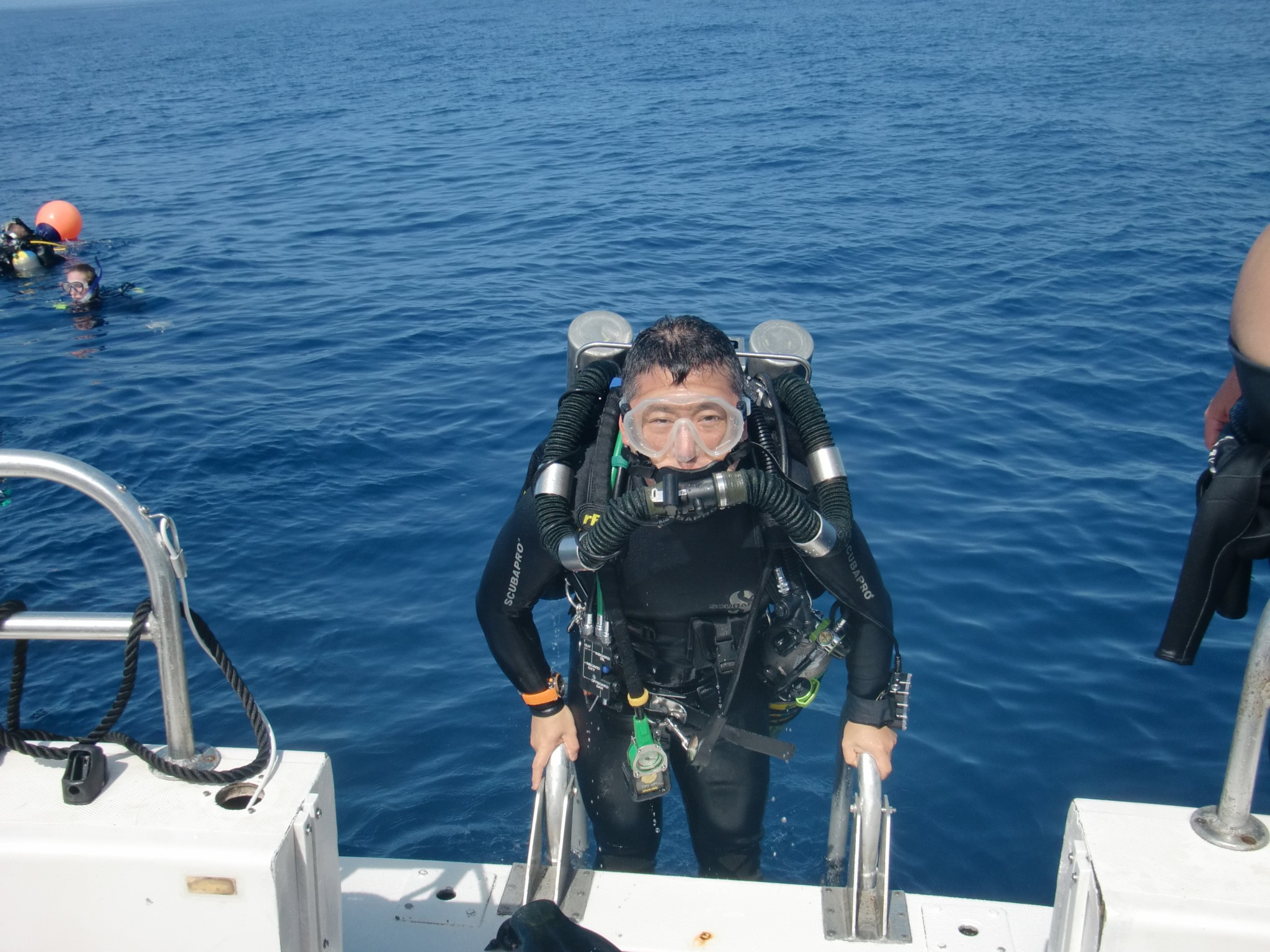
Perfect Conditions for a nice long rEvo CCR dive.

Perfect Conditions for a nice long rEvo CCR dive.

Good to go on his rEvo

Good to go on his rEvo

rEvo REBREATHERS
The rEvo rebreather is the brainchild of Paul Raymaekers, and is available in a number of configurations, which include different models, different electronics packages, and different case materials. Here we will try to make the explanation of the units as clear as possible.

rEvo I, rEvo II and rEvo III

The rEvo I was the original prototype units that were made to ‘work the kinks out’ when the rEvo was still in development. The rEvo II was the first production unit, and has also since been discontinued. While the II is no longer available, hundreds of them are out in the market being active dove, and many appear for sale in the secondhand market.

The rEvo III was designed and released to meet CE specifications, and today the only units for sale new, are rEvo III. The rEvo III is available in several different versions, in which the main differences are size and weight.

CO2 Scrubbing

All rEvo rebreathers come standard with back mounted counter-lungs, and dual 3 pound scrubber cassettes. These scrubbers are used in series, and increase the safety margin, reducing the risk of channeling and bypass.

As an option the RMS system allows for monitoring of your scrubber capacity, and provides a real-time estimate of how much time you have remaining.

For ultra-long dives, an optional radial scrubber system brings the absorbent capacity up to 8.8 lbs of absorbent.

PO2 Monitoring

The rEvodream is the standard PO2 monitoring device and head’s up display which comes on every rEvo unit. It can monitor your choice of one or 2 oxygen cells.

PO2 is displayed on a digital display which mounts to the submersible pressure gauge. The revodream will also display a range of PO2’s using a simple 3-LED display which clips to the DSV of the rEvo, always in view of the diver’s peripheral vision.

The rEvodream has no switches, and is operated by using a series of taps which actuates an internal accelerometer. Powered by standard CR2450 coin batteries, this simple design makes the rEvodream a very robust and reliable solution.

Each rEvo is sold with 2 PO2 monitoring devices, which includes 1 rEvodream PO2 monitor and HUD, and your choice of the following:
rEvodream PO2 monitor and HUD
Shearwater Predator trimix computer and PO2 monitor (hardwired)
Shearwater Predator trimix computer and PO2 monitor (Fischer cable version)
Shearwater Predator trimix computer and setpoint controller (hardwired)
Shearwater Predator trimix computer with RMS setpoint controller (hardwired Digital CAN bus)

Manual Gas Addition

Manual gas addition can be done in one of 2 ways, either through manual addition buttons found on the bottom of the rEvo case, or through a 3-gas addition block.

The 3-gas addition block hangs over the diver’s chest, and allows for ambidextrous addition of either diluent, oxygen or an offboard gas to be plumbed in through the lower quick-disconnect. The 3-gas block comes standard with the rEvo III Micro FT, and is an option on the rEvo III Mini and Standard models.

The case mounted manual addition buttons are found on the bottom of the rEvo III Mini and Standard models. These can be removed as an option. The rEvo III Micro FT does not have these buttons on it, and they cannot be installed as an option.

Automatic Oxygen Addition

Gas can be automatically added to the loop by either a constant flow orifice, and absolute pressure oxygen 1st stage. As the diver increases in depth, the absolute pressure regulator reduces the flow.

In addition, an optional solenoid via a Shearwater Predator controller may be added, providing automatic setpoint control in addition to the constant flow. Utilizing both a solenoid and constant flow creates a ‘hybrid’

On hybrid models, the constant flow orifice can be plugged, and the absolute pressure regulator may be replaced with a standard compensating regulator to allow for true eCCR operation.

Please contact us to setup  your pool demonstration today.

5/12 We’re Attacked By Scorpions!

Monday – A warm Sunny afternoon, we jump in a Koko craters.  There’s diving to be done, and we’re the best candidates for it.  A little fiddling with weight and ears and we make our way down to the little buddha.  A quick jaunt through one of the craters and a turtle comes and swims underneath us!  It’s blitzing.  After I get all my divers back, we head over to the big buddha and pass a moray on the way.  From there we bounce over to Turtle Canyon where we see two Devil Scorpionfish!  I didn’t even know the second was there!  Thanks everyone, stay wet.

Turtle Swims Under

Turtle Swims Under

So excited to dive maybe

So excited to dive maybe

Ready

Ready

Devil Scorpions

Devil Scorpions

Just keep Swimming...

Just keep Swimming…

Weather conditions:  Windy 10 kts, Small wind waves, Medium trade winds, Sunny.
Dive sites: Koko Craters, Turtle Canyon
Dive conditions: Koko’s: Light easterly current, 35ft, 78F; Turtle’s: No current, 40ft, 78F
Marine Life observed: Moray Eels, Scorpions! Green Turtles
Staff: Joe; Crew: Max; Instructors: Kellan