Bespoke scuba lesson client diving at fantasy reef in Oahu Hawaii

Bespoke Scuba Lessons

Bespoke Scuba Lessons

If you are looking for normal semi private 2 day scuba lesson, this is not the right page.  Go here.

Bespoke scuba lessons are available for anyone willing to invest in their new hobby by purchasing equipment.  However, if you have not yet done your first dive, the process will begin with a pool session and an open-water dive.  Executive-level private try dive instruction is $500.  Further training costs are reduced by this amount.

the kinds of people bespoke scuba diving lessons graduates meetCost of Bespoke Scuba Lessons

$1500 plus $750 per extra person in your private group.  Too much? Follow this link for no-purchase training starting at $595.  Bespoke lessons with 5 boat charters and private training are actually less expensive than retail. You are leveraging your equipment purchase with us.

Each client will purchase, at MSRP, a full set of scuba equipment with a minimum value of $3000.  This is not hard to achieve with a quality equipment purchase.  You will be advised in that purchase by your private instructor who will guide your purchases to fit the kind of diver you intend to be.  All set up of the equipment, and training in its use will be an integral part of your growth as a diver.  Scubapro, Aqualung, Oceanic, Mares, and Garmin, are some of the brands we deal with.

What is included in bespoke scuba lessons?

  • all private instruction
  • as much pool time as needed – your pool or ours
  • training in the use of YOUR new equipment
  • up to 5 boat charters – 10 dives (only 2 charters are required, the rest is our investment in your development)
  • Nitrox training (every diver should have this)

Who will be my private scuba instructor?

You may choose your staff member if you have met someone you admire.  Otherwise, our general manager will speak with you about your needs and we will assign one of our most experienced instructors.  Of course, you may change instructors if you wish.  It does not escape our notice that clients that are requesting this service are excellent customers, we will put you with our best, and OUR best are pretty awesome because they are all great.  If you would like to be trained by the owner, Dr. Matthew Zimmerman, it will need to be coordinated with the international dive trip schedule.

What will the schedule look like?

That is really up to you withing the constraints of the requirements.  Your private instructor is a working professional so you will need to be respectful of their time and not cancel last minute on them (reasonable emergencies excepted), but basically, you can decide on the schedule. Once and instructor is assigned and you have an idea of time required, the two of you can make a bespoke schedule.

You will have your private instructor on the water with you on regularly scheduled boat charters.  Private charters would incur an additional cost ($500 off the $1700 normal rate).  Equipment setup can occur in your home or at the shop (the shop would be better equipped to deal with any adjustments, it is also stocked with accessories you may find that you need/want).  The pool is yours or ours, whenever is convenient for you.  Your instructor is available for up to 5 2 tank boat charters and unlimited pool time.  Boats depart twice daily 7 days a week, so scheduling those is not an issue.

What certifications will I earn with bespoke scuba lessons?

Lifetime Open Water Certification is the primary certification you will earn.  If you have that already we will advance your ratings from where you are currently.

You will also earn a Nitrox certification.  Next, we will be spending a lot of time on buoyancy control. Enough to earn the Perfect Buoyancy rating as well.  Part of the dive education you will receive includes the difference between the two types of Advanced ratings. You will earn one or be on the way to the other, your choice.  Earn additional ratings at a small cost.

What’s next?

Many people come to us with a trip somewhere already booked and they want to dive when they get there.  Bespoke scuba lessons training will prepare you for that.

If you want personalized travel advice related to scuba diving we will put you in touch with the owner, Matthew Zimmerman, who runs the international dive travel program.  You can just get advice on where to go, or you can join a group trip.

Get started!

Send an email to info@islanddivershawaii.com and mention you are interested in bespoke scuba lessons.  That will start the private instruction and guided equipment purchase process.


Divemaster Internship in Hawaii

Divemaster Internship at Island Divers Hawaii

If you are interested in a Divemaster Internship at Island Diver Hawaii we welcome you to explore this page and determine if it will be a good fit for you.  This page is not a sales pitch.  An intern become an integral part of our operation, and we need you go in eyes wide open if you decide to take it on.

There are a number of things to consider

  • Divemaster internship result in SSI Divemaster certification
  • There is no staff housing or transportation available
  • We require that you have a personal set of dive equipment
  • Living in Hawaii is not inexpensive

Still interested?  Please go now to the SSI Divemaster Course page and educate yourself there, then come back here and continue.

How much does the Divemaster Internship cost?

$1500 USD plus 4.712% HI sales tax.  This is the only fee we will collect from you assuming you have met all the course prerequisites.  It includes your digital learning materials for Science of Diving and Dive Guide, as well as your dive briefing slate, so SSI pro swag, and your professional registration fee.  It is non refundable and yours to keep.

If you still need some course prerequisites we can do them before the internship starts for normal fees, or we can consider a custom plan that extends your internship and has reduced fees for courses.  Contact us for custom packages.

Insurance

We will require you to get the Master Plan or similar from Divers Alert Network, currently $42 a year plus $35 a year for the DAN membership.  Which will cover medical expenses if you are injured while diving.  Next, we are going to recommend using H2Oinsurance.com to insure your cell phone.  If you are doing the long version of the divemaster internship with free additional diving, you will be taking it underwater on almost a daily basis to take pictures. If you make a mistake one day with the underwater case – it can be expensive.  Therefore, insurance is recommended.

Professional Liablity Insurance is provided by us under a group policy if we hire you after the course is complete.

Gear

You only other cost will be the purchase of dive gear if you don’t already own it.  We will work with your budget on this, but even for used gear you are looking at $800.  New gear on the inexpensive end would be around $1500, and professional quality high end equipment about $3000.  We will apply 20% of of a gear package purchased at retail to offset your training cost.   So if you do make a $1500 purchase the credit of $300 will reduce your course fee.

Hawaii vs elsewhere

There are quite a few places worldwide that you can do divemaster internships.  Hawaii will not be the least expensive if that is the primary concern or goal.  Hawaii is pretty awesome though, especially Oahu, which has all the 1st world amenities.  It also has a pretty awesome underwater environment.

We will ask you to prove that you do have the financial means to support yourself while you are in your internship.  If you are just looking to complete the course, we can have you done in two weeks.  If you are going to extend the course by taking advantage of the free diving in return for taking pictures, you still need money to live and eat.

You earn your free diving by contributing to the guest experience during your internship period.

What will I be doing during my internship?

First, you get first hand experience working with guests and get very familiar with the dive sites.  There really is no substitute for experience.  You will have days with great divers that are a breeze, and you will have days with people that struggle with basic skills during courses and intro dives.  And every day you will be able to observe and work with full time professionals.

If choosing the DMCi option, you will enrich the experience of our guests by taking pictures of them diving.  This is what pays for the extra diving.

In addition, you will do everything that someone in an SSI Divemaster Course will do.  Again, you need to be familiar with that.  Go read that page now if you just skimmed it before.

Here is a list of things in likelihood of assignment that you might be asked to do if you are choosing the DMCintern path:

  • Go diving with guests and use the computer smart phone app Fotaflo 2 to deliver images to guests.  This is the primary function of our interns, and a smart phone is a DMCi We provide the underwater case.  There will be training involved.
  • Crew a boat.  Primary responsibility would be getting divers in and out of the water, assisting in vessel mooring, acting as a lookout, and supervising snorkelers if present. This would be surface supervision and boat handling.  Not common, but if you are DMCintern then you might get asked.
  • Assist with boat maintenance.  This will never be a primary task, but the people responsible can often do the work a lot faster with a second pair of hands.
  • Guide a snorkel tour. You will definitely do this, but dive is a Divemaster internship, not a snorkel guide internship.  Again, you are expected to be willing.  A watersport professional should be familiar with guiding snorkeling, which is 10x more common than a scuba tour.
  • The random thing.  Things come up.  Whatever it is, you are part of the team and are expected to help if you are taking the DMCi route

Your assigned mentor will be tracking your progress.  You’ll need to be posting photos to our service in most cases to receive credit.  It is worth noting that in the case that you are participating in direct Divemaster requirement training, you can still be posting pics and getting credit.

Professionalism

Behavior

This can actually be a little tricky. Not so much because we have a hard time getting interns to be professional, but because of the relaxed, easy going nature of our operations.  What can happen is that you begin to forget that you are representing the business -and then you tell that off color joke.  Or, you start discussion about last night’s party in front of the guests and how X did something crazy.  Or you are annoyed at one of your classmates and you snap at them in the shop. Finally, while we do not forbid dating within the company there are absolutely not discussions about personal relationships or showing of affection during work hours.

Non of the above is acceptable.  The shop is open from 7am to 7pm, and as long as you are on premises your are expected to conduct yourself in a professional manner.  If it becomes a problem, you will be asked to leave.

Drugs

Additionally, there is no tolerance for the use of any drugs besides alcohol and nicotine. Your momma probably told you shouldn’t smoke, and she is right. We reserve the right to report your smoking to her.

Customer Service

Finally, we are in the customer service business.  Here is a story I tell all my incoming staff. “The divers may not remember what they saw on the dive in a couple of months, but they will remember how they were treated by the staff forever”.  You can’t control the conditions, and marine life is finicky.  But we can absolutely can control the guest experience by making an effort to make people feel welcome every day.  We learn their names, what they do, where they are from, and where they have dove.  And then we are excited about the dives we do with them.  Presto, new dive friends. This is who we are, and that needs to be you if are an intern here.  Rudeness, snappiness, or just plain ignoring our guests will result in the termination of your internship.  That is the way it has to be.  Good news here: it is not that hard to be nice.  It is a little harder to be nice EVERY day.

How long is a divemaster internship?

Well, if you are doing DMC quick, a couple of weeks full time.  If you are doing DMCi (intern), then you are streching it out for gaining experience and “paying” for your extra boat dives by taking pictures of our guests and sending them to them.  Some weekend only interns have taken as long as 6 months.  At some point we’d like to graduate you and start using you as paid staff if you are going to stay around.

What will I learn not directly related to the divemaster program?

  • Filling tanks
  • Picture delivery training.  How we deliver guest photos.  You’ll learn this from your assigned mentor almost immediately, you can’t finish your internship without posting.
  • Boat crew orientation and some seamanship basics.
  • Introductions to Fareharbor (booking software), so you can see when you are assigned to a boat, and DiveShop360 (point of sale software), so you can help a customer with a simple purchase if needed.
  • Answering the phone and greeting guests.

Can I get a job after my divemaster internship?

Probably.  But most of the work we have, such as training divemaster candidates, requires an instructor level certification.  You may get the occasional dive guide work if all of the full time instructors are busy.

It is not uncommon for divemasters to fall in love with the job.  To really work full time in the industry you are going to need to take the next step. Instructor. You are also going to have to hold a legal US work permit to actually get paid in the US, which is not the case for an internship.  Another option is working in the shop as shop staff, combined with divemaster work.

All inclusive cost for the course Assistant Instructor, Open Water Instructor and Instructor Examination is $3500 plus HI sales tax.

Let’s say your internship is over and you want to stay involved.  You can stay on and enjoy the benefits of diving, by simply volunteering your time once a week.  Many of our divemaster graduates have full time jobs, and come out on weekends and help as needed.  Our customer base is a mix of island visitors and locals, and we have an active dive club.  We can always use a hand on weekends.  Attention military:  earn your DM with us, we will use you on weekend boats!

2021 Master Diver Challege

2021 Master Diver Challenge

The 2021 Master Diver Challenge

SSI has updated their 2021 Master Diver Challenge program and now there are three prizes to win in 2021.  One each for Master Diver, Advanced Open Water Diver and Specialty Diver.  This is an awesome opportunity to win free trips around the world just for doing the dives and courses you already want to do this year!  At our shops there are group courses planned every weekend and we can organize a scuba certification course for you at any time added onto our daily boat charters. You can qualify for a Specialty Diver rating with only one charter if you have 12 logged dives. This program is truly for everyone.

How to earn the free certifications

SSI - Scuba Schools International - my.divessi.com - Register Now

In the SSI system Specialty Diver, Advanced Open Water Diver and Master Diver are all free ratings. You get there by booking specialty courses and logging dives in your MySSI App.  You can click on the picture here to get the free app and start a variety of free programs right away.  Enter to win these prize by earing these FREE certifications:

  • Specialty Diver
    • 12 logged dives
    • 2 specialty certifications
  • Advanced Open Water
    • 24 logged dives
    • 4 specialty certifications
  • Master Diver
    • 50 logged dives
    • 5 specialty certification one of which much be Stress and Rescue

The 2021 Grand Prize for Master Diver2021 Master Diver Challenge Grand Prize

group photo from 2007 Egypt dive tripThe Grand Prize is a liveaboard trip for 2 people to the Red Sea on an Aggressor liveaboard.  Can be completed anytime in 2022.  The prize has a value of $5400.  That is pretty amazing.  Island Divers did a liveaboard trip to the Red Sea in 2007.  The diving was fantastic and we added on a week to go explore the antiquities of Egypt.  We used another operator but I know that Aggressor can arrange this extra week as well.  It was a combination of the upper Nile temples and tombs and Cairo for the pyramids.  The upper Nile was our favorite.  Karnak temple being the highlight in our opinion.


Here is a high quality link Red Sea Master Diver Challenge for 2021 to the prize description.


2021 prize for earning Advanced Open Water2021 Master Diver Challenge Prize for Advanced Open Water

The prize for earning you Advanced Open Water in 2021 is a single space at the Blue Angel dive resort in Cozumel.  It is based on dbl occupancy, so you’ll need to bring a buddy or pay for a single supplement, but it is still a great prize.  Island Divers Hawaii Dive Travel plans a trip here every couple of years.  Here is a past example.

2021 Master Diver Challenge Prize for Specialty Diver

2021 prize for earning Specialty Diver

The prize for earning your Specialty Diver rating is 4 days of diving and 5 nights hotel at the Looe Key Reef Resort in Florida.  Also based on double occupancy.  What is great about this prize is that almost everyone can enter to win.  Without even coming to Hawaii you could book a Nitrox Course and a Marine Ecology course, have logged at least 12 dives, and SSI will issue you a free Specialty Diver rating and automatically enter you to win.  That is pretty amazing.  We can set this courses up for you at anytime, from anywhere, just give us a call.

I love it, how can I get started?

Easy.  Keep logging your dives in the free MySSI app.  SSI regularly updates your profile with courses and dives and automatically applies your free earned ratings and enters you to win.  Prizes are awarded in January of 2022 after everyone that earned the rating that year is entered.  So all you need to do is start earning those specialty certifications.  If you are visiting Oahu and booking dives with us, the easiest to add on is Nitrox for $125.  That is the world’s most popular specialty and a good one to have.  Nitrox does not require dives, so you can actually do it remotely. However, most people want to dive the gas during the course.  Another easy way is to add on a fully online Ecology course, like the Marine Ecology course we have planned for March 20th.   For dive club members, probably the best way is to join one of are Group Continuing Education courses that happen all year long on weekends.


How the SSI Master Diver program works

How to achieve the Master Diver rating with SSISSI Master Diver challenge details

As Island Divers Hawaii shifts its training focus from PADI courses to SSI, one common questions is how does this affect my progress towards the Master Diver rating.  SSI calls this rating Master Diver and PADI calls it Master Scuba Diver.  They are very similar ratings.  However, the SSI rating has some pretty large advantages..

To achieve the Master Diver rating with SSI you need to

  • Log 50 dives
    • These dives need to be logged in the MySSI app.  Since not all divers are habitual dive loggers, this is the minor disadvantage mentioned earlier.  If you have been logging elsewhere, there is a shortcut that a dive center can help you with.  As an SSI dive center, we can access your SSI diver profile and manually change the number of logged dives in the system for you.  We’d are happy to do this for our divers that have logged dives elsewhere.
  • Complete the Stress and Rescue specialty
    • SSI treats the Rescue course as a specialty course.  There is no need to achieve the Advanced Open Water rating prior to starting the course.
    • A prerequisite for stress and rescue is React Right or an equivalent CPR First Aid certification
  • Complete 4 more Specialty courses
    • There is an extensive list of specialty courses available.  Interestingly with the SSI program, none of them have to be specialty courses that include diving.  Meaning that a diver that is interested in pursuing the Master Diver certification with SSI can complete many of the course requirements from the comfort of their home.  This includes Nitrox
    • We recommend that one of these specialty certifications be the online nitrox course.  Nitrox certification allows you to dive nitrox.  While all the specialty certifications are going to expand your knowledge base, there are only a few that are required for a certain type of diving.  Diving with nitrox is one of those that will require certification.
    • Currently, almost all our specialty courses are $125 without dives.  So, for ecology programs and the like that do not require diving, that is the final cost.  Most other specialties can be completed with one set of boat dives.  Again, if you are reading this from somewhere with no local diving, you can complete your online learning in advance and just schedule your dives when you are able to come to Hawaii.

Once these are completed, SSI will automatically recognize you with the Master Diver rating.  Meaning, once your instructor certifies your last specialty in the SSI system and you have 50 dives you will be automatically awarded the Master Diver Rating.  There is no $50+ application fee.  The fee that PADI charges for this is one of the reasons we believe the SSI system is better.

It is worth noting that along the way to Master Diver in the SSI system, you will also get the Level II Specialty Diver* rating and teh Level III Advanced Open Water Diver** rating for free.  Achieving each of these ratings is automatic upon getting the specialities and logging the dives and you also get entered to win dive trip prizes.

*12 dives logged and 2 Specialties  ** 24 dives logged and 4 Specialties

What do you get with the SSI Master Diver rating?

Entry into a yearly drawing for a liveaboard dive trip for 2 people.  Each year SSI takes all the people that achieved the SSI Master Diver rating and puts them into a drawing.  In early 2020 the winner for the 2019 Master Diver Challenge was announced.  Nate Kilgore is the lucky winner in the picture on the right.  He won a liveaboard trip for two on the Belize Aggressor.  In 2020 the winner will got a liveaboard trip for 2 on a liveaboard trip to Honduras.  Here are the 2021 prizes.

Master Diver rating is Level 4 diver in the SSI recognition path, Level 5 diver is the next recognition level with 100 dives.  The SSI Master Diver level is primarily a personal achievement.  It is also the goal of our dive centers to encourage people to shoot for this goal.  We have been doing this a long time.  Many people come out of their certification course and just stall, not sure what to do next.  We like Master Diver as a goal because it includes training that is going to help you be a better diver and be able to better assist dive buddies (Stress and Rescue).  Also, if you make the 50 dives logged goal you really gone from being certified to being a true diver.  For many of us that work here, this has been our primary hobby and source of friends and adventures for years.  It is a worthwhile goal.

If I’m currently holding PADI certifications, how can I switch?

SSI is pretty generous in this regard.  Your initial certification can be with ANY training agency.  SSI lets you count any two specialty courses with any other training agency towards the Master Diver rating.  Stress and Rescue and 2 other SSI Specialty courses must be part of your profile.

If you have specialty courses from another training agency SSI allows us to verify those certifications in the SSI app.  Let us know if you need this.  We will need photocopies of the card.  Big bonus for doing this is that your card will go into your SSI diver profile and be available for free for life!  Just like all of your SSI cards.

Remember, that as the dive center we call manually adjust your number of dives if you are not yet using the dive log on the MySSI App.


Certified scuba diver

Octopus and Scorpionfish Galore!

We had a great variety of divers of all skill level on our afternoon charter today. Wendy, Jeffrie, and Miche were discovering the wonder of the underwater world; Melissa was starting her Advanced Open Water; Taylor, Abigail, and Nikolas were doing their Open Water courses; and Shannon, Russ, and Charles were getting back to diving after a brief hiatus. The wind was blowing in Maunaloa Bay and there was a slight chop on the surface.

It took us about ten minutes to reach our first stop: Koko Craters! Underwater, the visibility was spectacular and the current was minimal. We saw several turtles, a few scorpionfish, and even an octopus! There were plenty of damselfish darting around the Buddha statue and schools of surgeonfish swimming between the craters.

Our next site was Turtle Canyon. This was quite an exciting dive. We saw a turtle getting cleaned with a huge moray eel next to it right off the bat! As we continued along the reef, we saw many smaller eels darting in between the coral heads, lots of little tangs and damselfish, and even stumbled upon three large scorpionfish. On our way back to the boat we watched a small porcupine fish swim about and took a look at a helmet conch. One group even saw an octopus!

Everybody had a fantastic day underwater, even though it was a little windy and choppy on the surface. Nikolas is now a certified diver; Taylor and Abigail will be soon; Melissa will finish up her Advanced Open Water in the next few days; and Wendy, Jefferie, and Miche are on their way to becoming certified themselves!

Koko Craters and Turtle Canyon: max depth 40ft

Staff: Capt. Joe; Instructors Chelsea, Alex, and Jim; Deckhand Mikaela


Birthday Diving 10*24*2014

Today on the Sea Fox we had a single student and a hand full of certified divers going out on the afternoon dives. The trades were light and the surge and current were moderate in strength. Today’s dive sites were Pa’a’awa and Koko Craters.

tang Green Sea Turtle, Honu

The bottom conditions were their normal spectacular selves: 60ft visibility and a warm 81 degrees at the bottom. The surge and current were moderate and noticeable. There were many standout creatures today: a baby octopus, dragon moray, spanish dancer, pincushion starfish, scorpion fish, and a giant Hawaiian Sea Turtle.

Big Buddha, Koko Crater OLYMPUS DIGITAL CAMERA


Happy Birthday to Lisa! Thank you for spending your birthday week with us on the boat. It’s been a blast to dive with you!

Congratulations to Mike for completing his Open Water Course. Now you’ve got to take your advanced with us so you can keep up with your wife!

A big thank you to the crew: Capt. Joe, Max, & Larry

It just comes naturally…

Today on the Sea Fox, we had a large group of Discover SCUBA Divers, students finishing their Open Water, and SCUBA Refreshers. The conditions were spectacular as usual in Oahu, 60-80 ft viz at both Koko Craters and Pa’a’awa with mild surge and current.

20140816_144314

A whole HOST of aquatic animals came to out to greet the new and refresher divers. Green Sea turtles, sergeant majors, trigger fish, puffer fish, giant green morays, devil scorpion fish, an expired 7-11 crab, and an octopus delighted the undersea heroes.

Moray EelDCIM100GOPRO


Congratulations to:

Bryan – DSD 1st and 2nd dives EVER!!
Peter & Mark – 1st dive in 5 & 15 years respectively
Clay & Jake – Completion of the PADI Open Water Diver Course

Many thanks to you guys for coming out. You guys looked great in the water. Diving, for you guys, definitely comes naturally.

Shout out to the CREW!! Capt. Joe, Alex, Marnie, & Jess

Dive Stats:
Koko Crater & Pa’a’awa
36ft – 44min & 40ft – 48min

Returning from the deep

Returning from the deep

Returning from the deep

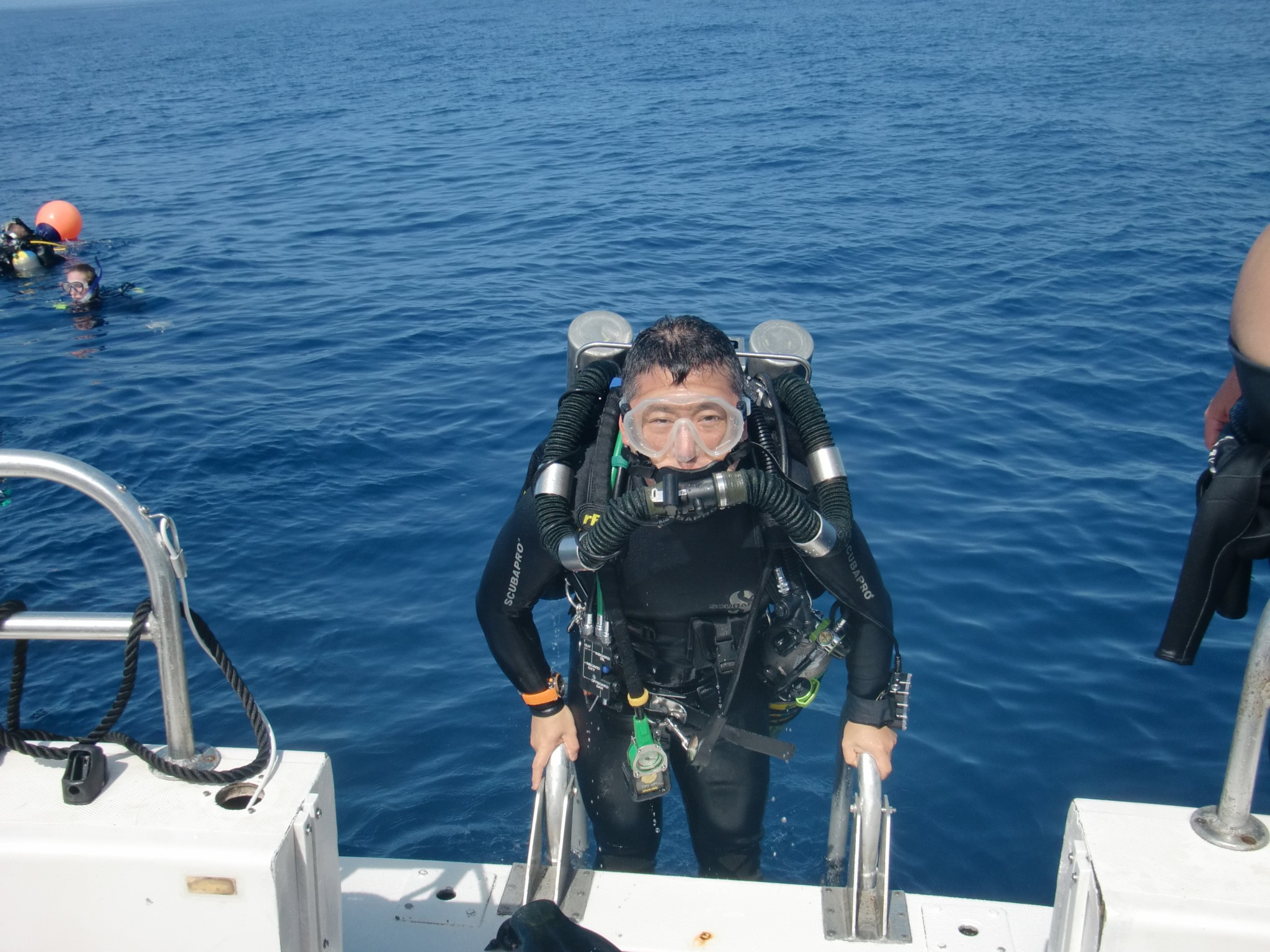
Perfect Conditions for a nice long rEvo CCR dive.

Perfect Conditions for a nice long rEvo CCR dive.

Good to go on his rEvo

Good to go on his rEvo

rEvo REBREATHERS
The rEvo rebreather is the brainchild of Paul Raymaekers, and is available in a number of configurations, which include different models, different electronics packages, and different case materials. Here we will try to make the explanation of the units as clear as possible.

rEvo I, rEvo II and rEvo III

The rEvo I was the original prototype units that were made to ‘work the kinks out’ when the rEvo was still in development. The rEvo II was the first production unit, and has also since been discontinued. While the II is no longer available, hundreds of them are out in the market being active dove, and many appear for sale in the secondhand market.

The rEvo III was designed and released to meet CE specifications, and today the only units for sale new, are rEvo III. The rEvo III is available in several different versions, in which the main differences are size and weight.

CO2 Scrubbing

All rEvo rebreathers come standard with back mounted counter-lungs, and dual 3 pound scrubber cassettes. These scrubbers are used in series, and increase the safety margin, reducing the risk of channeling and bypass.

As an option the RMS system allows for monitoring of your scrubber capacity, and provides a real-time estimate of how much time you have remaining.

For ultra-long dives, an optional radial scrubber system brings the absorbent capacity up to 8.8 lbs of absorbent.

PO2 Monitoring

The rEvodream is the standard PO2 monitoring device and head’s up display which comes on every rEvo unit. It can monitor your choice of one or 2 oxygen cells.

PO2 is displayed on a digital display which mounts to the submersible pressure gauge. The revodream will also display a range of PO2’s using a simple 3-LED display which clips to the DSV of the rEvo, always in view of the diver’s peripheral vision.

The rEvodream has no switches, and is operated by using a series of taps which actuates an internal accelerometer. Powered by standard CR2450 coin batteries, this simple design makes the rEvodream a very robust and reliable solution.

Each rEvo is sold with 2 PO2 monitoring devices, which includes 1 rEvodream PO2 monitor and HUD, and your choice of the following:
rEvodream PO2 monitor and HUD
Shearwater Predator trimix computer and PO2 monitor (hardwired)
Shearwater Predator trimix computer and PO2 monitor (Fischer cable version)
Shearwater Predator trimix computer and setpoint controller (hardwired)
Shearwater Predator trimix computer with RMS setpoint controller (hardwired Digital CAN bus)

Manual Gas Addition

Manual gas addition can be done in one of 2 ways, either through manual addition buttons found on the bottom of the rEvo case, or through a 3-gas addition block.

The 3-gas addition block hangs over the diver’s chest, and allows for ambidextrous addition of either diluent, oxygen or an offboard gas to be plumbed in through the lower quick-disconnect. The 3-gas block comes standard with the rEvo III Micro FT, and is an option on the rEvo III Mini and Standard models.

The case mounted manual addition buttons are found on the bottom of the rEvo III Mini and Standard models. These can be removed as an option. The rEvo III Micro FT does not have these buttons on it, and they cannot be installed as an option.

Automatic Oxygen Addition

Gas can be automatically added to the loop by either a constant flow orifice, and absolute pressure oxygen 1st stage. As the diver increases in depth, the absolute pressure regulator reduces the flow.

In addition, an optional solenoid via a Shearwater Predator controller may be added, providing automatic setpoint control in addition to the constant flow. Utilizing both a solenoid and constant flow creates a ‘hybrid’

On hybrid models, the constant flow orifice can be plugged, and the absolute pressure regulator may be replaced with a standard compensating regulator to allow for true eCCR operation.

Please contact us to setup  your pool demonstration today.

A Great Way to Try Diving before Signing up for a Scuba Class

There are different scubaA Great Way to Try Diving before Signing up for a Scuba Class diving experiences you can try before committing to your certification.  You might not be sure how you will like diving underwater and to make a financial commitment can to something you have never experienced before can be daunting.  Island Divers Hawaii offers a few different programs to give you your first experience of breathing underwater without being certified.

If you are not confident yet to dive in the ocean you can give it a try in the pool first with our Bubble Maker Experience.  This course allows you to slowly descend into the shallow end and practice your breathing techniques. Once you are comfortable, you then slowly swim to the deep end of the pool to practice a few diving skills, to make you feel more confident in the water, and a few games to learn how to control your movements underwater.

The next option is a Discover Scuba Experience which combines the confined water training in the pool with your first instructor supervised ocean dives. Going into your first ocean dives you will have the skills to know how to keep calm and comfortable while enjoying the amazing aquatic world around you.

If you are comfortable in the water and just cannot wait to swim with the fish, you can jump right in with Island Divers Hawaii Intro Dives. We teach you the few intro skills like clearing your mask, recovering your regulator, and clearing your regulator right there on the anchor line before you descend for your first amazing instructor supervised 20 minute dive!  After you return to the boat and have a snack, you can jump back in with your instructor and enjoy another dive without worrying about any skill training you accomplished on the first dive; it’s just fun diving from there!

Now you are ready and you know exactly what you have been missing!  So on to your certification and here at Island Divers Hawaii we have the best price on the island for your Open Water Certification, only $195!  If you’re looking for more private classes on your own time, we offer this any day of the week for a competitive price of $495.  If you complete a Discover Scuba Dive Experience with us, you can give us only two more days of your time and we can make you a certified diver for only $395!  You can see Island Divers Hawaii offers many options tailored to what works best for you.  We want to give you every opportunity to enjoy one of the best experiences on Earth!

Call us and start diving today.

Open Water Certification in Hawaii

Open Water Certification in HawaiiHawaii has been a popular diving location for many years offering year round warm waters and some of the most famous dive sites in the world. Diving in the Hawaiian Islands is popular for its underwater topography and incredible diversity of fish species, over 30% of which are found nowhere else in the world. There are amazing formations like lava tubes and caverns formed from volcanic eruptions.

Oahu, one of the 7 main Hawaiian Islands, offers a range of scuba diving options, from shore dives to boat dives, from the beginners to advanced dives. During a dive you will more likely to see colorful reef fish, coral, sea turtles, octopus, lobster, shells of different shapes and sizes, and much more. Hawaii has more than over 650 species of reef fish, and 200 of these fish are unique species not found anywhere else in the world. When scuba diving off Oahu’s coast, unique species of marine to look out for are moray eels, frogfish, scorpion fish, marine flat worms, nudibranchs, shrimp and giant sea turtles.

Once certified, diving depths range from 30 to 105 feet. On the North Shore, you can dive in Shark’s Cove nearby Waianae Bay in the summer. Depths run to 45 feet and sights include a reef with caves, lava tubes and ledges. The variety of diving depths available makes Oahu a great place to get certified to dive.

Open Water Diver training is your gateway to the world of scuba, providing you with full PADI (Professional Association of Diving Instructors) certification that qualifies you to dive with a buddy to depths of 60ft anywhere in the world for your entire lifetime. *Note: as of 2020 Island Divers Hawaii primary certification agency is SSI (Scuba Schools International).  This is now our default training agency, though PADI courses are still available for higher prices.

You’ll go from your first introduction to dive theory, all the way to making free open ocean descents. Once you’ve completed your certification, you’ll be ready to start exploring the waters right off the coast from shore dives to any of the dive boats that we charter regularly.

What do you look for to find a reputable Dive Center?

It is important to find the right Dive Center to learn how to scuba dive. Even though it is easy to learn how to scuba dive it is a serious sport that involve some risks; however if you are taught properly it is easy to avoid these certain risks or know what to do if they ever arise. Main criteria to look for in a dive center are:

  • What type of scuba diving training is offered?
    Preferably you want a dive center who offers courses from Professional Association of Diving Instructors or PADI. This organization is more widely accepted around the world. Look to see which ones from the initial list is a PADI Dive Center, or A PADI 5 Star Dive Center which offers more courses and services then a regular Dive Center. IDC stands for Instructor Development Course which is the training program required to train Scuba Instructors. Therefore a PADI 5 Star IDC Dive Center would offer the highest level of certifications as well.
  • How diverse are the courses that they offer?
    At this point you would want to look on their webpage to see what courses they offer. Does the course list match the areas of diving that you are interested in; such as underwater photography, Deep Diving, Wreck diving, or on a more professional level Divemaster or Scuba Diving Instructor certification.
  • Narrow The List by Scuba Equipment inventory and knowledge:
    Scuba diving is an equipment intensive sport. It is most helpful if your Dive Center sells and services scuba equipment. If they have a good inventory of items on hand and if the sales people in the Dive Center are knowledgeable about the products that they carry, then they are seasoned and well informed about the diving industry. Some of the major lines of scuba equipment are Aqua Lung, Scuba Pro, Oceanic, Aeris, Sherwood, and Suunto dive computers (to name a few).

Who can become Open Water Certified?

Anyone 10 years of age or older in good health is qualified to begin Open Water training. For prospective divers between the ages of 10 and 14, they may participate in the Junior Open Water Program, which is a slightly restricted form of the normal Open Water certification.

You will be required to verify your health by signing the standard medical statement before class begins. If you have a yes to any of the medical questions you will need to get cleared by a doctor before being able to participate in Scuba Diving.

What is the classroom like?

The class is conducted over the course of 2 full days or our week long course is conducted in the evening from 6-9pm Monday thru Thursday with your check out shore dives on Saturday and Sunday.

You’ll begin by completing the digital learning. It’s nice to know why we do certain things underwater, like equalizing our ears. The digital learning is coupled with learning in the pool. We’ll cover everything from what each piece of equipment is called, to teaching you the basics of neutral buoyancy. Everyone is encouraged to participate and ask questions during the class so you’ll know how it all works inside and out..

Once all the pool work is over, you move to the ocean for your open water dives. With instructor supervision, you’ll demonstrate all the skills you practiced in the pool and spend a part of each dive exploring the underwater world. The Open Water program requires you to complete four dives in the ocean, and we’ll be with you the entire time, coaching you along the way. You won’t do anything in the ocean that you didn’t do in the pool, so by the time you get to the ocean, you’ll be rock solid with all your skills.

Where will you learn?

One of the benefits of participating in Island Divers Open Water certification is the flexibility you have with how you want to structure your class. Everyone’s time demands, ability to travel and budgets are different, so we’ve developed options to allow you to choose different paths towards certification.

The most popular option is the 2 day semi private course with a student the instructor ratio of 4:1.  You will go to the pool each morning and do a 2 tank boat dive in the afternoon.